
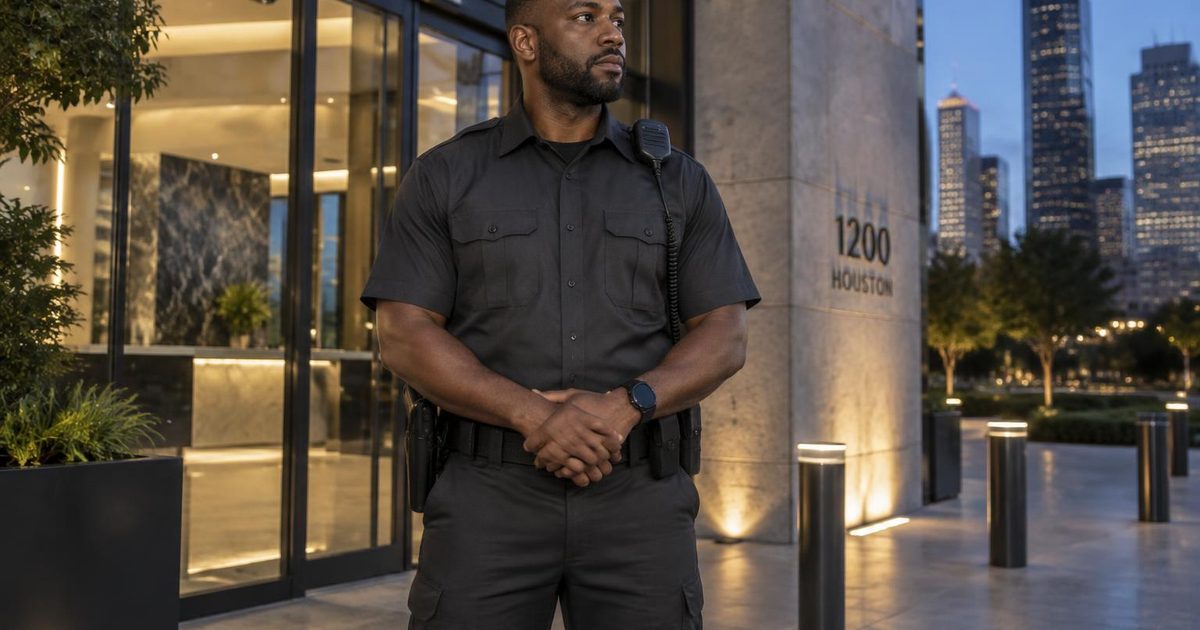
Choosing between armed and unarmed security guards is one of the first decisions a Houston business owner or property manager faces when evaluating professional security services. The right answer depends on your environment, the nature of your risk, the people your property serves, and what you want the visible security presence to communicate.
This guide covers the practical differences, the situations where each is appropriate, and the questions to ask before making the decision.
If you are in immediate danger
Call 911 first for any emergency or crime in progress. Our office line and request forms are for non-emergency coordination and follow-up coverage.
What Makes a Security Guard Armed?
An armed security guard carries a firearm while on duty and, in Texas, must hold a Level III commissioned officer license through the Department of Public Safety. That license requires additional training, a psychological evaluation, and ongoing range qualification beyond what an unarmed officer needs.
Licensing is the first dividing line.
Texas unarmed officers hold a Level II registration. Armed officers hold a Level III commission, which involves a longer training course, a demonstrated firearms proficiency standard, and stricter renewal requirements. Any provider offering armed coverage should be able to confirm the commission status of every officer assigned to your post.
Armed presence changes the environment.
A visibly armed officer signals a higher level of deterrence, but it also changes how employees, customers, tenants, and visitors experience a space. For some properties that signal is exactly right. For others it creates tension that works against the atmosphere the business is trying to maintain.
Armed coverage costs more.
Higher licensing requirements, higher insurance exposure, and a smaller pool of qualified personnel all push armed rates above unarmed rates. The premium is justified when the risk profile calls for it. When it does not, the money is often better spent on more unarmed coverage hours or better reporting.
When Unarmed Security Is the Right Call
Most commercial and residential security needs in Houston are well served by professional unarmed officers. Unarmed coverage is typically the right starting point for:
Office buildings and corporate campuses.
Access control, visitor management, lobby presence, and after-hours patrols are core unarmed functions. The goal is a professional, welcoming presence that also enforces policy, and an armed officer is rarely necessary to achieve it.
Retail and customer-facing environments.
Visible uniformed presence deters shoplifting and disorderly conduct while keeping the environment comfortable for customers. Many retailers deliberately choose unarmed coverage for exactly this reason.
HOA and residential communities.
Gate attendance, amenity patrols, parking enforcement, and resident assistance are relationship-driven work. Communities generally want an approachable officer residents feel comfortable talking to.
Construction and industrial sites.
Overnight equipment and material protection is primarily about presence, patrol discipline, and documentation. Unless the site stores unusually high-value assets or has a documented threat history, unarmed coverage is the standard.
When Armed Security Is Worth the Investment
Armed officers are the appropriate choice when the risk profile includes a credible threat of violence or when the value at stake justifies the higher level of deterrence. Common situations include:
Cash handling and high-value inventory.
Businesses that move significant cash, jewelry, pharmaceuticals, or other high-value portable goods face a different threat profile than a typical office. Armed coverage raises the cost of attempting a robbery and is often an insurance expectation.
Documented threats or prior incidents.
If your property has experienced armed robbery, credible threats against staff, or violent incidents, the risk assessment changes. Armed coverage becomes a reasonable response to a demonstrated threat rather than a speculative one.
Certain event profiles.
Large cash-based events, high-profile attendees, or events with a known protest or disruption risk may warrant armed personnel as part of a layered security plan.
Late-night and isolated operations.
Businesses operating late hours in isolated locations, where law enforcement response times are longer and staff are few, sometimes choose armed coverage as a risk offset.
Questions to Ask Before You Decide
The armed versus unarmed decision should come out of an honest assessment, not a default preference. Before you commit, work through these questions:
- Has the property experienced violent incidents, or only property crime and nuisance issues?
- What do your tenants, employees, or customers expect the environment to feel like?
- Does your insurance carrier or lease agreement specify a coverage level?
- Is the primary goal deterrence, response capability, or documentation and reporting?
- What does the surrounding area's crime data actually show for your property type?
- Would more unarmed hours or better patrol verification deliver more value than an armed post?
A trustworthy provider will walk through these questions with you and recommend the level that fits your situation, including telling you when unarmed coverage is sufficient. Be cautious of any provider that pushes armed coverage as a default upsell.
A Layered Approach Often Works Best
Many Houston properties end up with a blend rather than a single answer. Common combinations include:
Unarmed officers plus mobile patrol.
A stationary unarmed officer at the main access point, backed by marked patrol passes through the rest of the property, covers more ground than a single post at a comparable cost.
Armed coverage for peak risk windows only.
Some businesses run unarmed coverage during normal hours and bring in an armed officer for closing procedures, cash transport windows, or specific high-risk periods.
Officers plus camera systems.
Mobile security camera systems extend an officer's reach across large sites. Cameras watch the perimeter while the officer focuses on access points and response, and the recorded footage strengthens your documentation.
How VantagePro Security Helps Houston Businesses Decide
VantagePro Security provides both armed and unarmed officer services across Houston and the surrounding metro, and we treat the choice between them as a risk assessment question rather than a sales question. When you contact us, we start with your property, your incident history, and your goals, then recommend the coverage level that actually fits, whether that is a single unarmed officer, an armed post, or a layered plan.
Every officer we place is licensed through the Texas Department of Public Safety at the level their post requires, and every engagement includes documented reporting so you can verify the coverage you are paying for. To talk through your situation, call us at (281) 335-6445 or request a quote through our website.